Damage models are used to evaluate the limit state of a material during plastic deformation. They allow determining the conditions under which the material will begin to fail or develop defects (cracks, breaks, etc.).
The use of these models helps to:
•identify areas of potential failure;
•optimize technological processes – identify critical metalworking modes and minimize risk of defects.

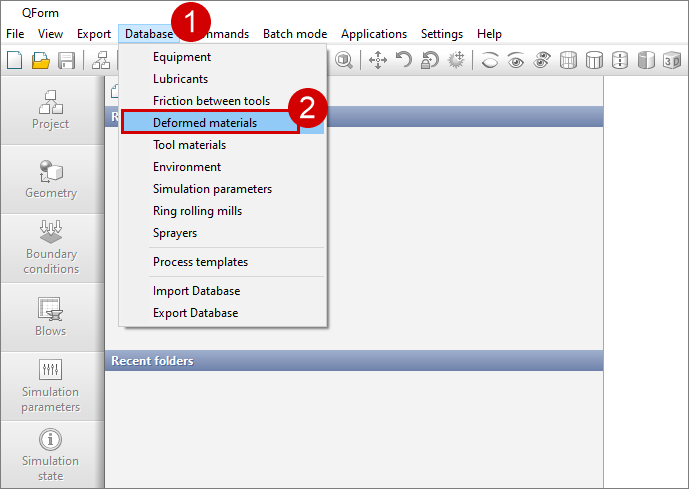
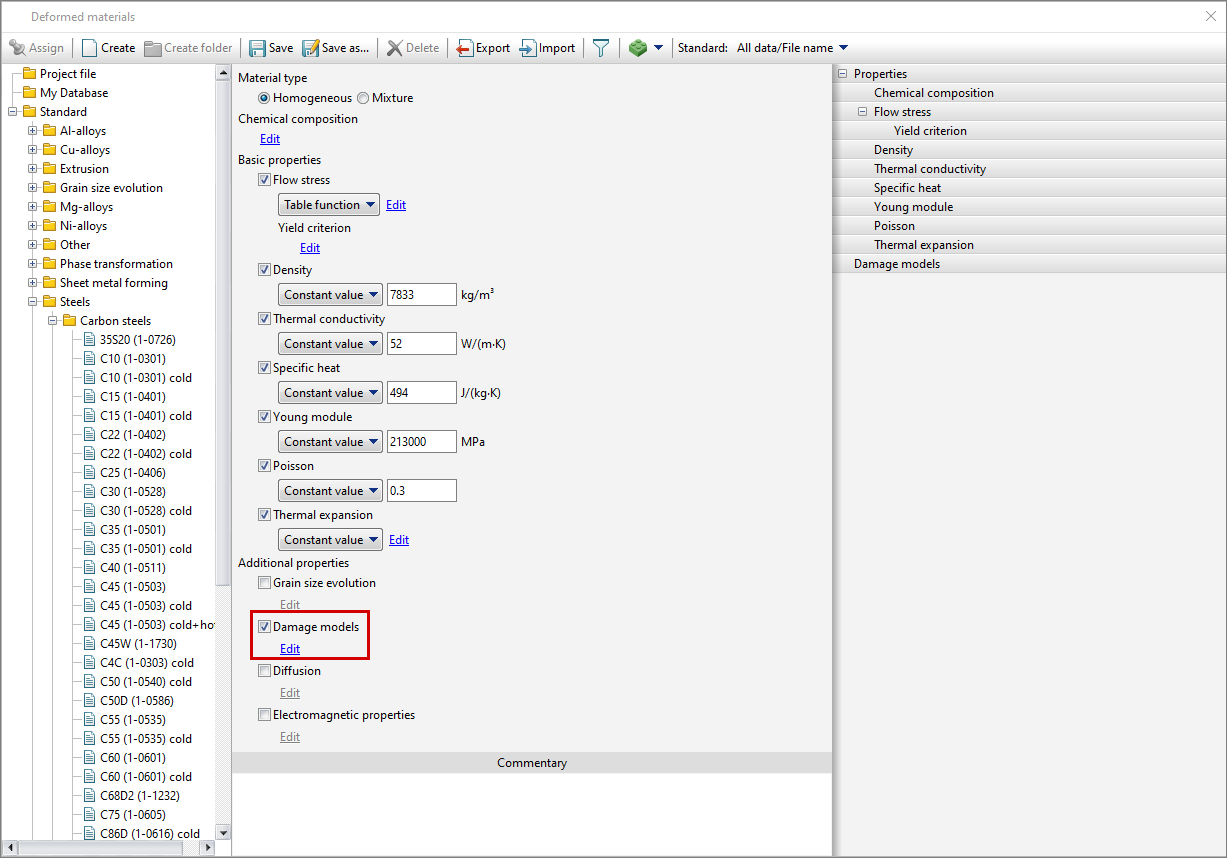
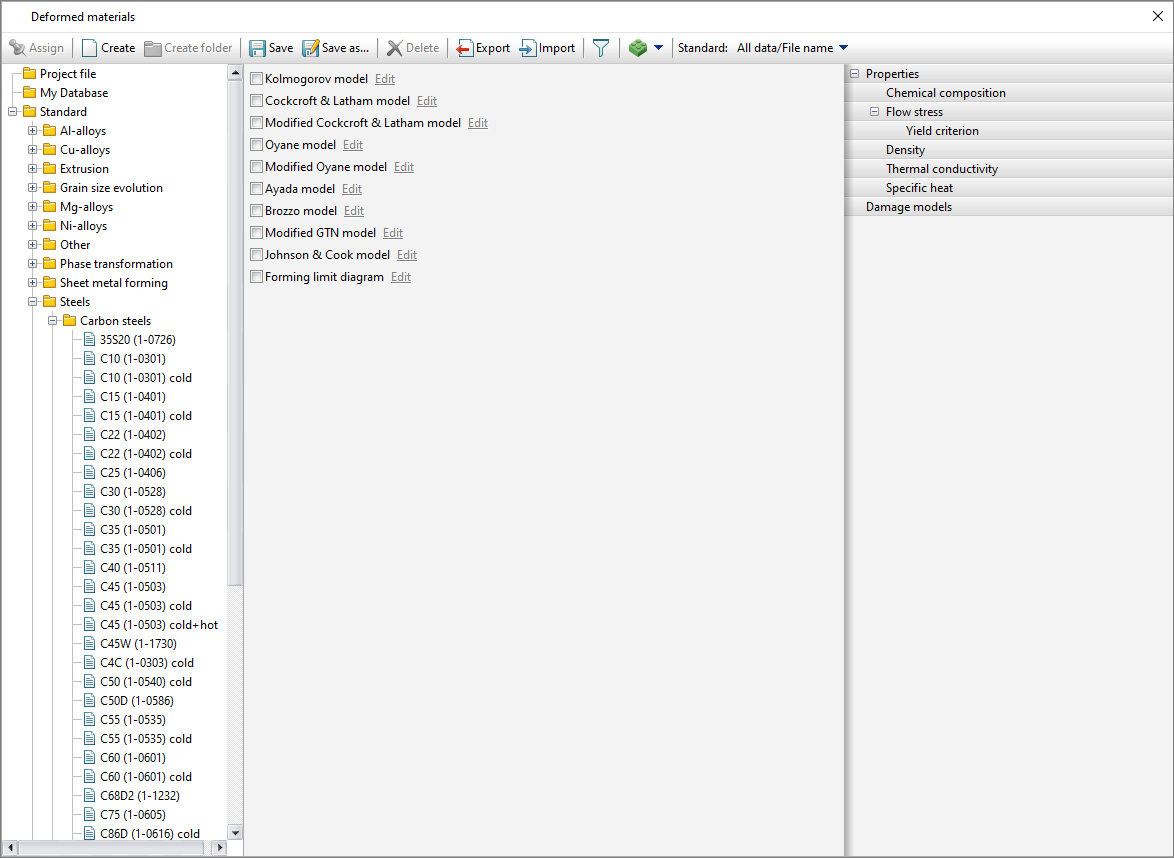
To select and configure a damage model, follow these steps: 1.Go to the deformed materials database. 2.Select the right material. 3.Activate the additional property – Damage models. 4.After activation, the Edit button will appear, click on it. 5.In the opened list, select an appropriate model: •Kolmogorov model; •Cockcroft-Latham model; •Modified Cockcroft-Latham model; •Oyane model; •Modified Oyane model; •Ayada model; •Brozzo model; •Modified GTN model; •Johnson-Cook model; •Forming limit diagram. 6.After selecting the model, the Edit button will becomes active - click it to enter the required model parameters. |
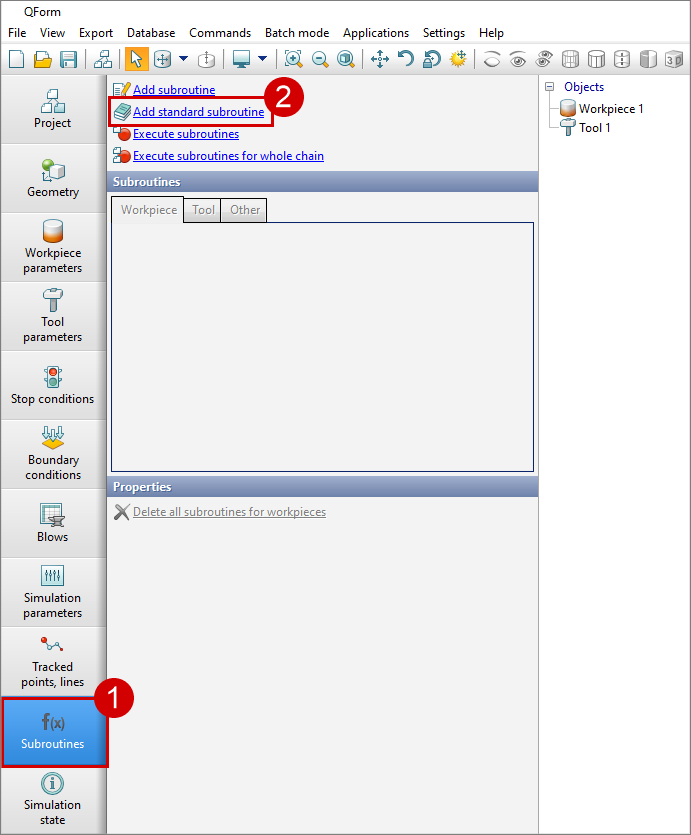
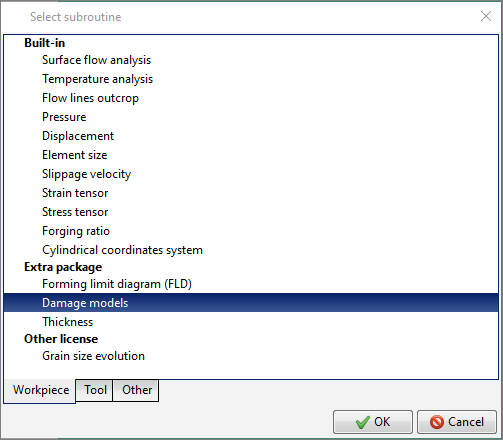
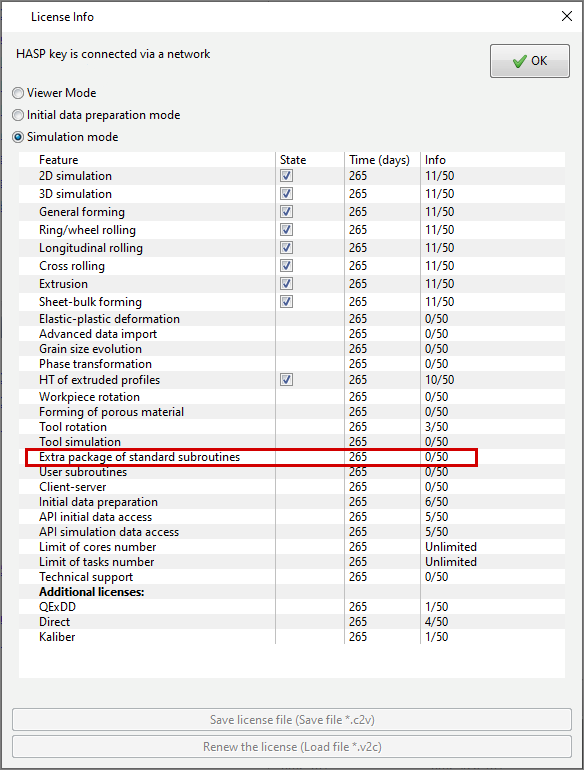
1.Open the Subroutines tab. 2.Click Add standard subroutine. 3.From the list, select Damage Models.
4.Execute subroutine. Upon completing the calculation, you'll obtain data that helps analyze critical areas of the construction, identify weak spots, and take measures to prevent material failure. |
||||

Below are descriptions of various damage models.
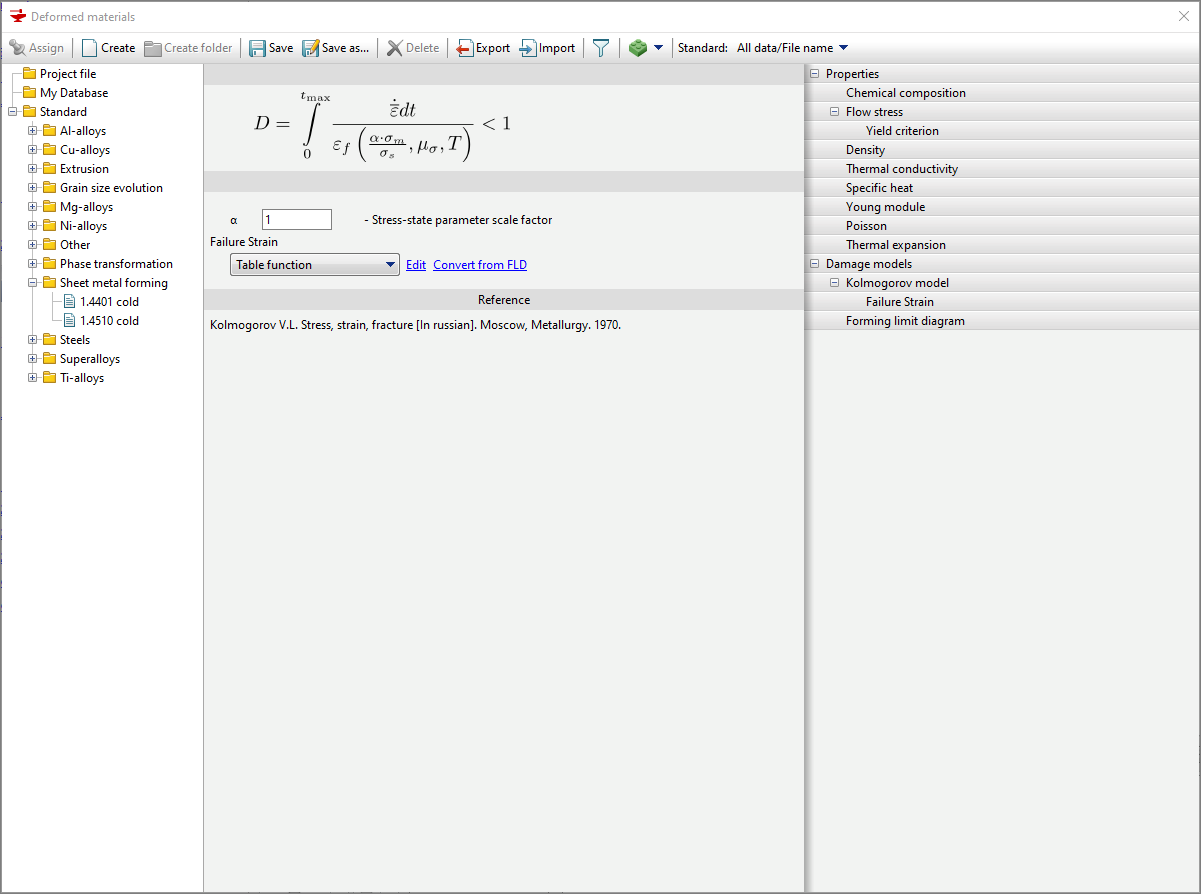
The failure criterion proposed by V. L. Kolmogorov is based on accounting for accumulated damage in the material subjected to external loads. It assumes that failure occurs when the sum of relative strains normalized by their respective failure strains reaches a certain threshold value. This approach takes into account the influence of temperature and stress state on the material's failure process.
How does the formula work: 1.The integral accounts for the accumulation of damage over time. 2.Failure occurs when D reaches 1. 3.The function εf demonstrates how the failure strain depends on the stress state and temperature.
|
||||


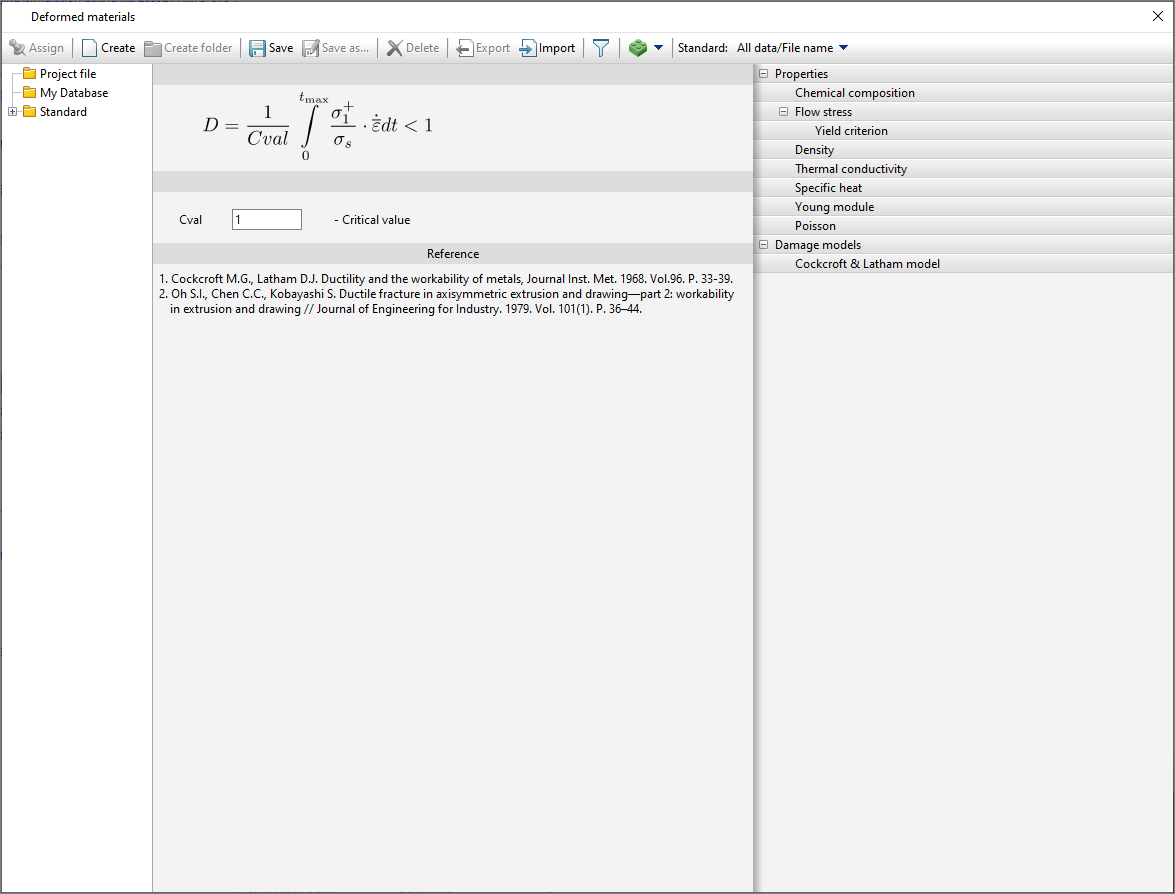
This model represents a material failure criterion based on the accumulation of plastic strain and taking into account the maximum principal stress. It was proposed by Cockcroft and Latham and is widely used to predict metal failure during plastic deformation.
The Cockcroft-Latham model is designed to predict material failure, particularly under conditions of plastic deformation and high stress. The criterion considers the importance of principal stress in the development of microcracks and macrocracks, making it useful for analyzing brittle fractures and ruptures in metals and alloys.
|
||||


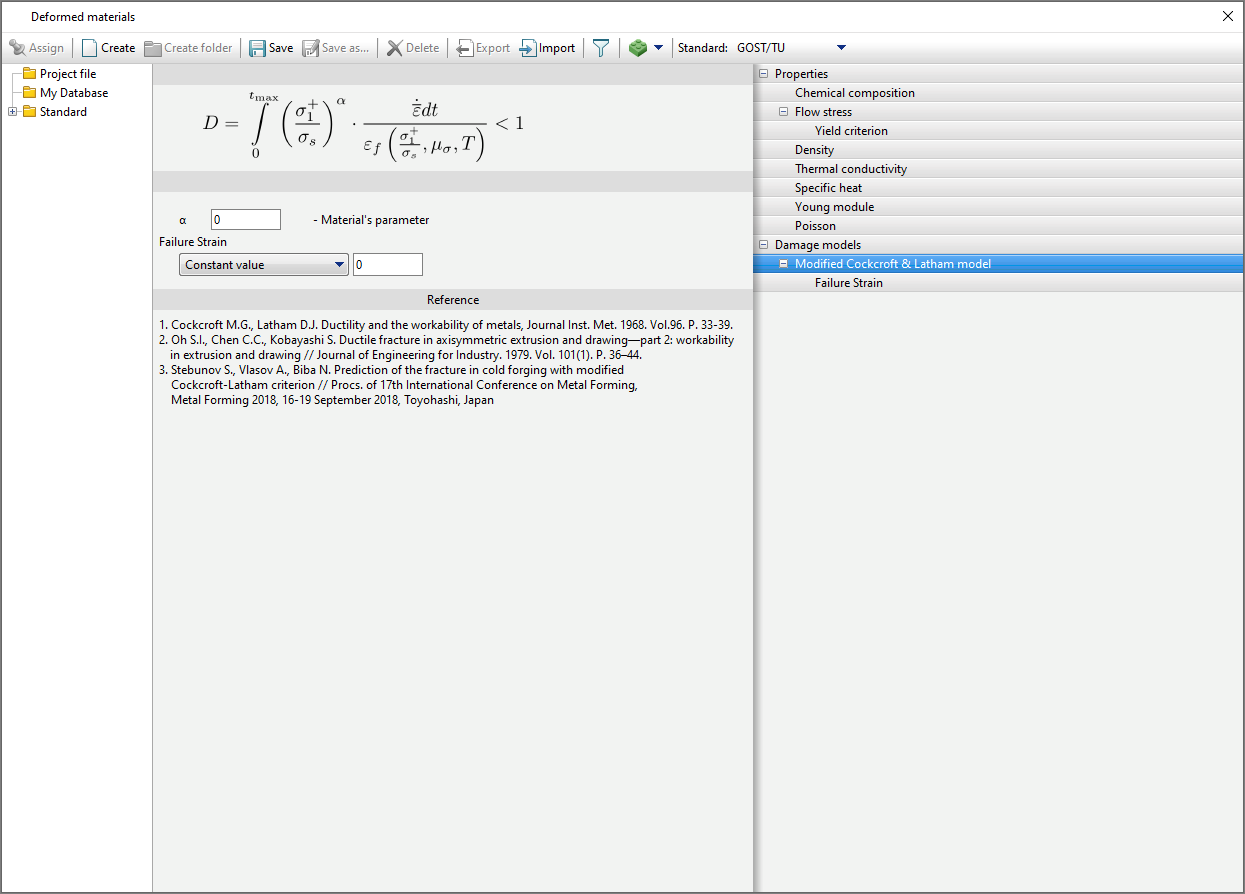
The modified Cockcroft-Latham damage model represents an enhancement of the original criterion, incorporating additional factors influencing the material failure process during plastic deformation. Unlike the basic model, the modified approach may incorporate parameters such as temperature effects, strain rate, and material anisotropy into the calculations.
•the ratio σ1+ / σs. • • The modified Cockcroft-Latham model is extensively utilized in engineering practice to predict material failure under complex loading conditions. It is used in: •modeling hot rolling and forging processes: considering temperature and strain rate factors enables more accurate prediction of cracks and defects in manufactured items; •analysis of material behavior under high-speed loads: e.g., impact or explosive loads, where strain rate plays a critical role; •designing components considering material anisotropy: such as composite materials or rolled products with directional structure.
|
||||


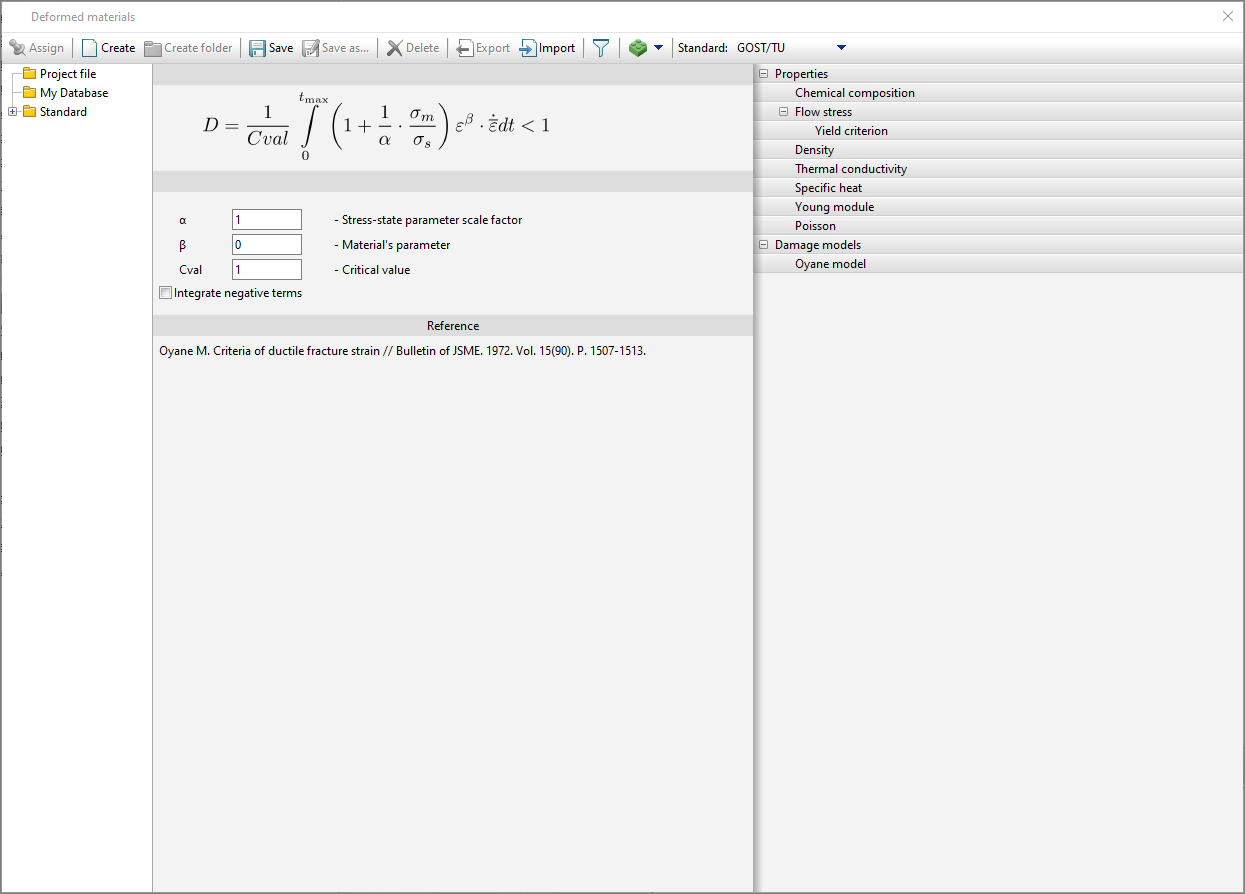
The Oyane damage model is used to describe the conditions of material failure under complex stress states. It takes into account the accumulation of plastic strain and the effect of hydrostatic pressure on the failure process.
The model is based on the accumulation of damage over time. The main parameter is the damage indicator D, which is integrated over time, taking into account the stress state and strain rate. Stages of using the model: 1.Material Parameter Determination •Experiments are conducted to determine the constants Cval, β, α. 2.Numerical calculation of stress state •Finite element methods are used to find σm, σs, deformation fields. 3.Numerical integration •The accumulated damage parameter D is computed over time. 4.Failure Assessment •If D ≥ 1, the material is considered to have failed.
|
||||


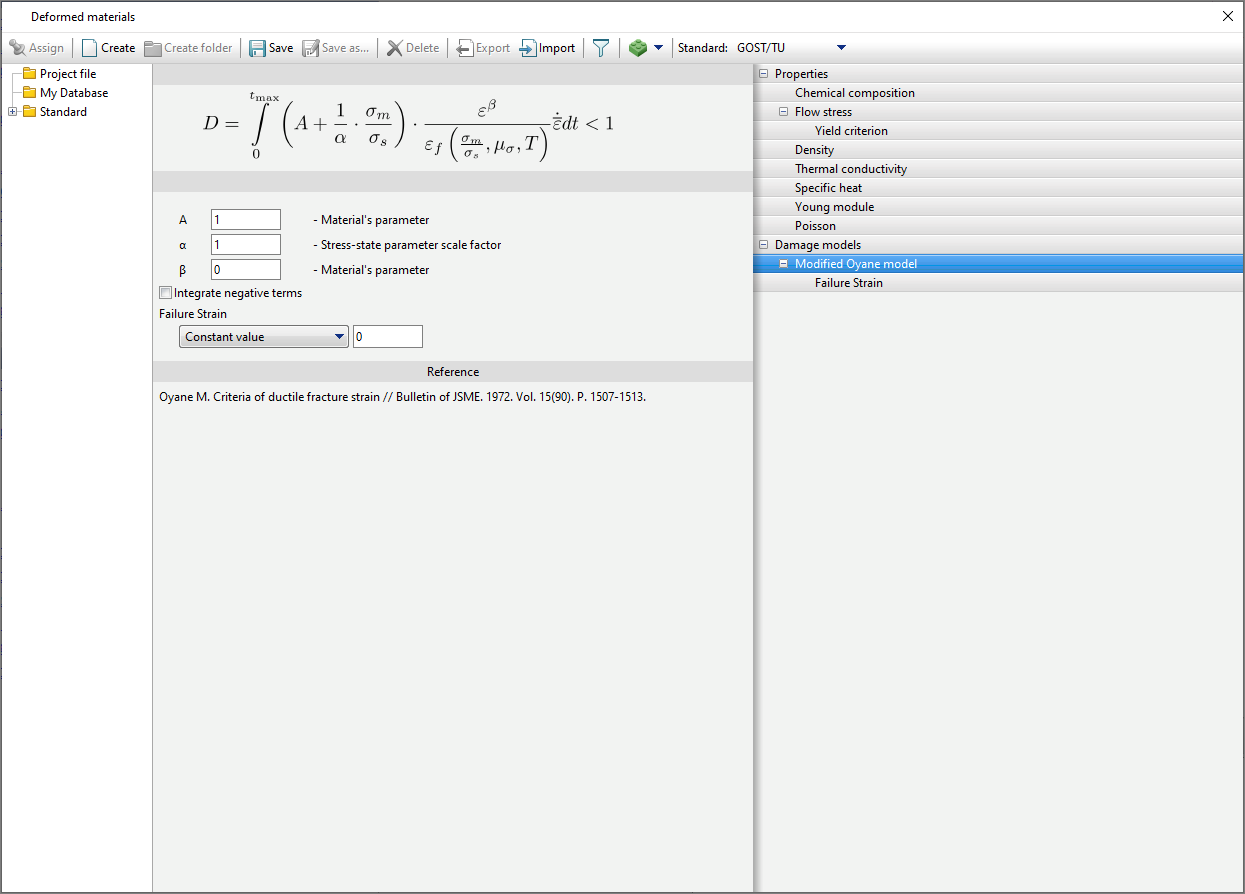
The modified Oyane model is applied for more precise prediction of material failure under complex stress-strain conditions. Unlike the classical Oyane model, the modified version takes into account additional factors affecting material damage, such as: •Temperature T •The mean stress σm influences the damage via an empirical function •Microstructural parameters of the material
•ratio σ1+ / σs. • • The Modified Oyane Model is an enhanced version of the classic model, providing more realistic calculations. It's especially useful in situations where temperature, material microstructure, and complex stress states significantly affect failure.
|
||||


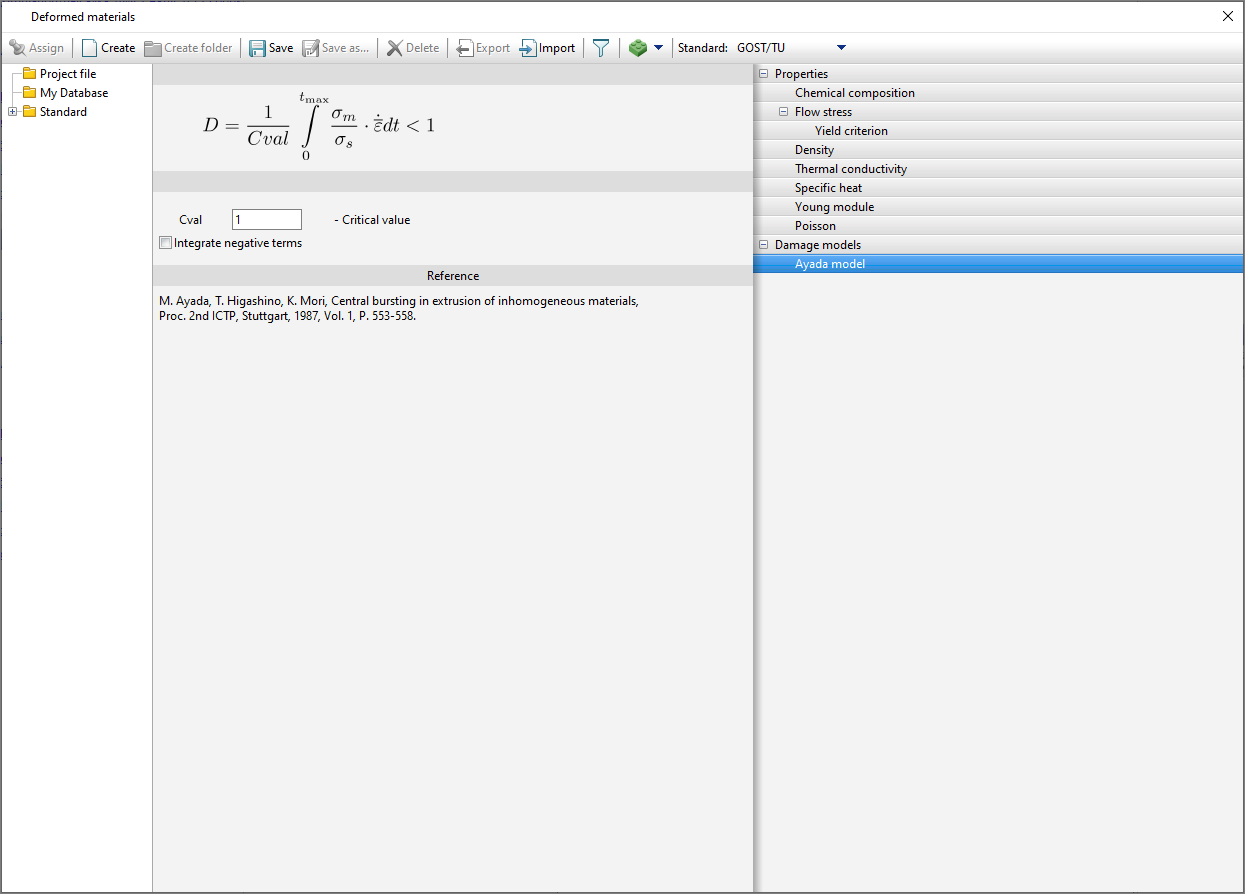
The Ayada damage model is one of the engineering models used in fracture mechanics to evaluate the ultimate state of a material under the accumulation of plastic deformations. It is widely used to describe the failure of metals under cyclic and static loads, particularly in aviation and machinery industries.
The material fails when the accumulated value of plastic strain reaches a certain critical limit, which depends on the stress state, temperature, strain rate, and other factors.
|
||||


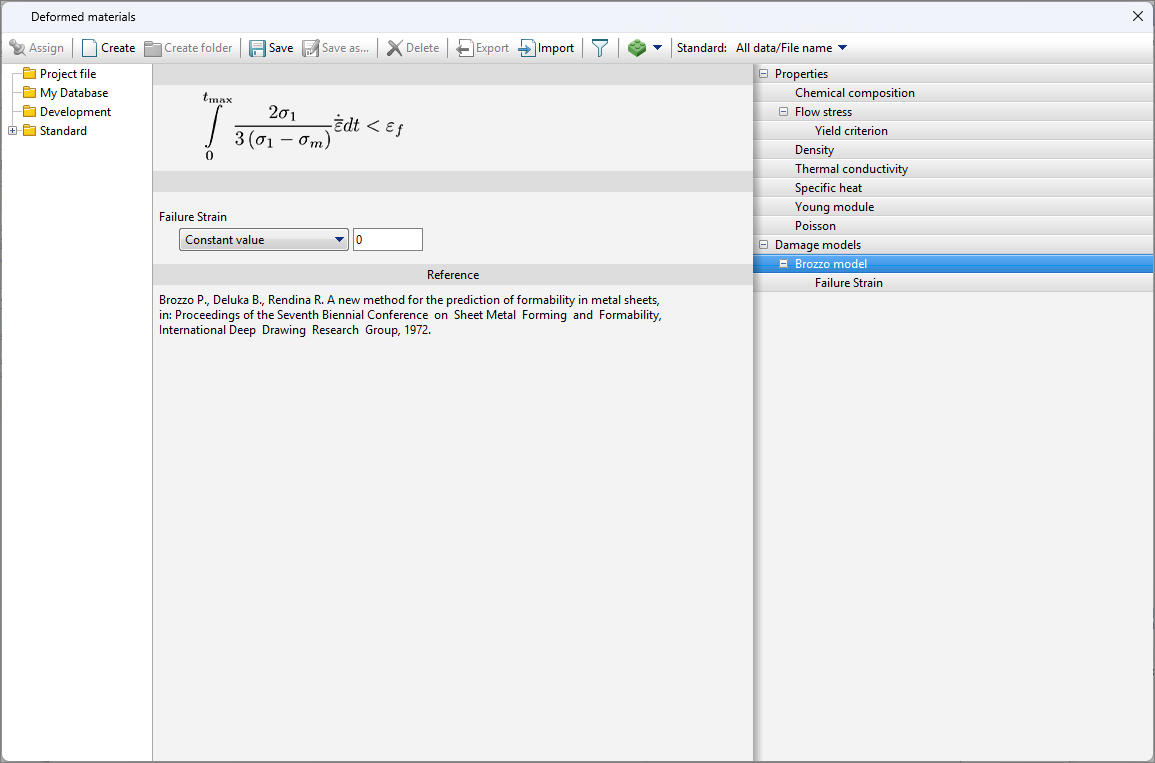
The Brozzo model belongs to the class of local failure criteria used to describe the onset of damage under complex stress conditions. In this model, the failure criterion is reaching a certain limit of accumulated plastic strain, modified to account for the stress state shape.
This model allows predicting the moment of localized failure in the presence of stress and strain gradients, especially under triaxial stress conditions, where conventional strength criteria prove insufficient.
|
||||


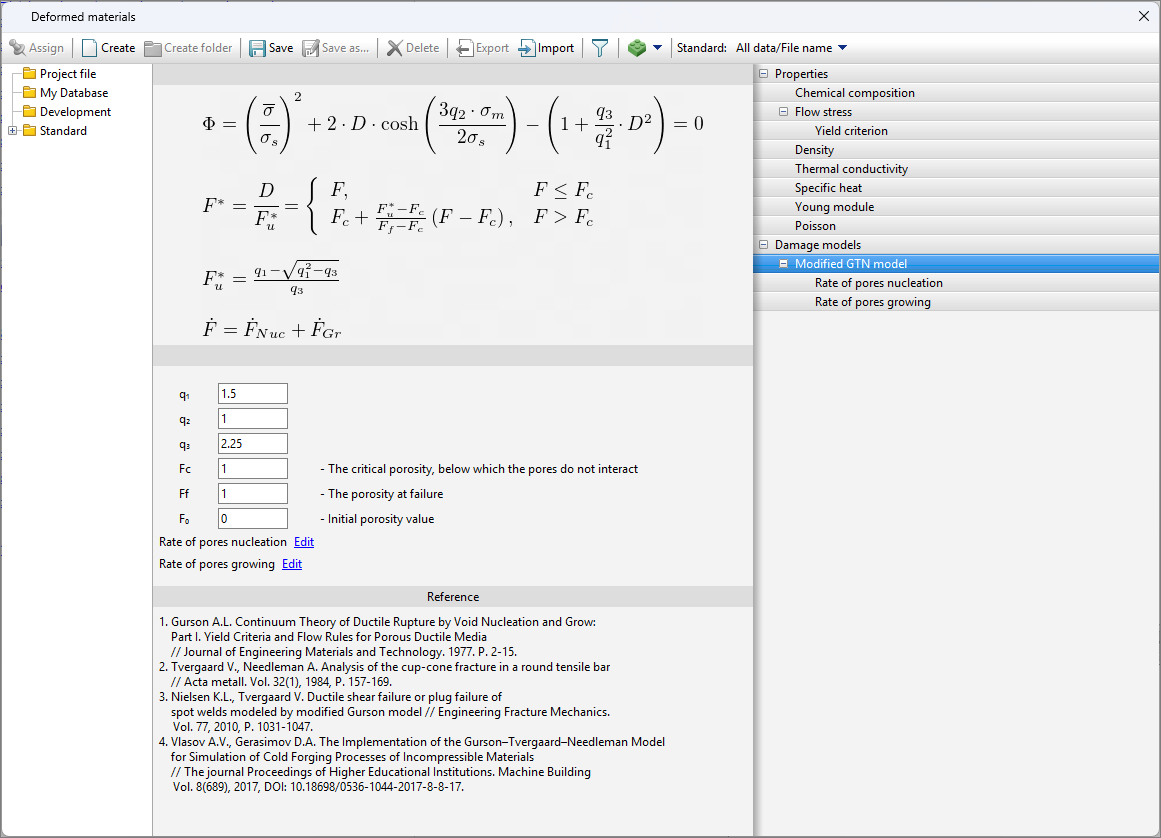
The modified Gurson-Tvergaard-Needleman (GTN) model is a physically-based material damage model that describes the process of micropore nucleation, growth, and coalescence in metals, ultimately leading to material failure. It is particularly important in problems related to the analysis of metal strength and plasticity under large deformations, specifically in stretching, deep drawing, cutting, forging, and other forming processes.
The GTN model and its modifications are used for: •simulation of damage accumulation in ductile metals; •evaluation of residual strength of components with defects (cracks, voids); •Prediction of failure during plastic deformation; •simulating shock loads, especially when the damage stage prior to complete failure is crucial; •predictive modeling of crack formation without manually specifying cracks.
|
||||


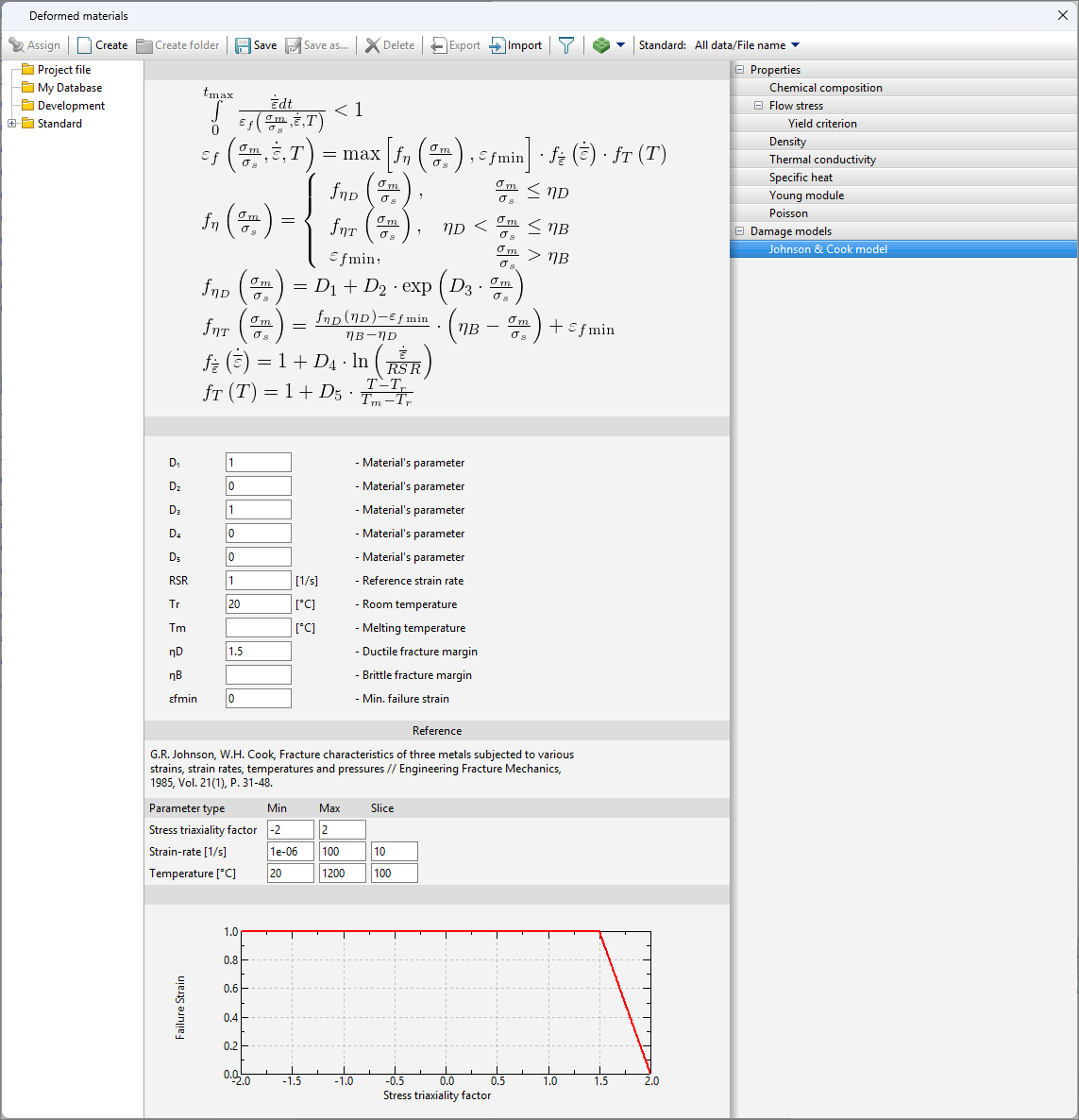
The Johnson-Cook damage/failure model is widely used in fracture mechanics and numerical simulations of metal deformation and failure processes under extreme conditions — high strain rates, temperatures, and pressures.
The model is used to estimate the ultimate plastic strain, upon reaching which material failure initiates, followed by complete sample failure. It is based on the premise that material failure does not occur instantaneously but gradually accumulates with increasing plastic deformation.
|
||||


For more detailed information about the forming limit diagram, refer to the documentation section titled Application of the Forming Limit Diagram. |