Ring rolling is characterized by continuous deformation of the workpiece with a cyclically moving deformation zone. In this case, special algorithms that will be differ from the approach to bulk forging simulation are needed. Simulating processes with a rotating workpiece requires much more computational time, special algorithms for storing and recalculating information at the nodes of the calculation mesh. The number of steps in the simulation can exceed several thousand.
Two finite element meshes are used in the Ring rolling operation type:
•calculation mesh for creating the stiffness matrix and solving the system of plastic flow equations
•geometry mesh that contains the information about the thermomechanical fields obtained during the simulation and better save the geometry
The calculation mesh on the workpiece in the contact with the guide rolls is not refined, as guide rolls stabilize the ring and do not participate in the forming.
|
|
|
Calculation FE-mesh |
Geometry FE-mesh |
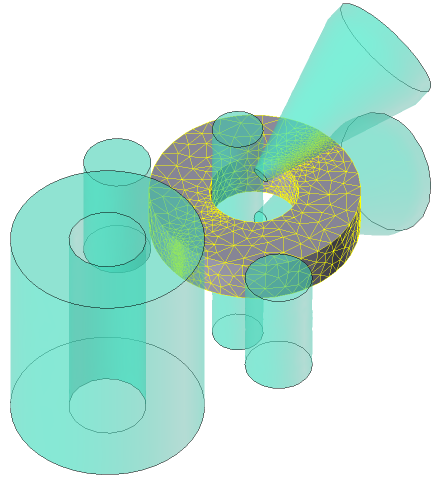
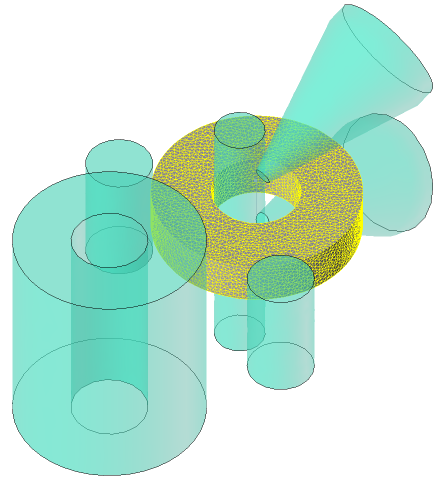
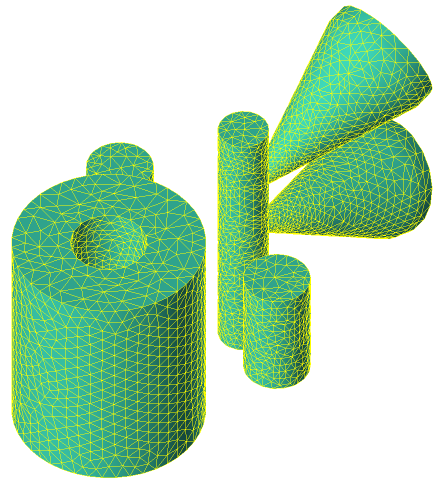
As all tools are axisymmetric, tools mesh do not rotate during process simulation. At the same time, it was found that no need to additionally reduce elements on the tools at the contact areas. Such approach can significantly reduce the time required for simulation with saving the accuracy.
|
FE-tools mesh |
See also:
Requirements for the initial geometry