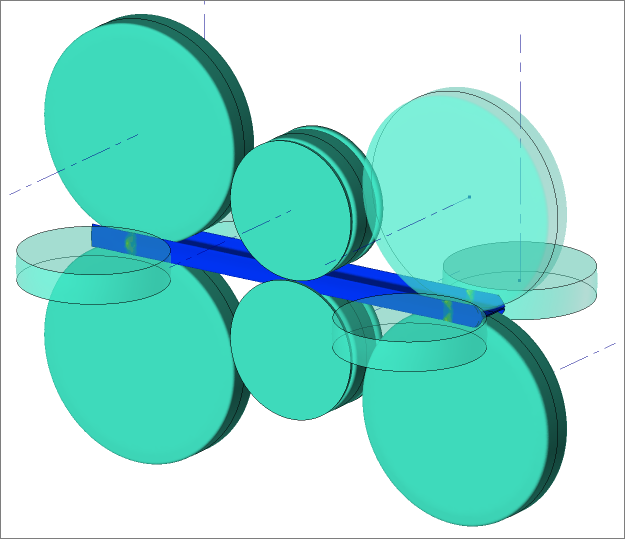
Simulation of longitudinal rolling processes has its own specific features; for this reason the dedicated Longitudinal rolling module was developed. It enables reliable results that reflect the specifics of the process while keeping the input data definition simple.

Unlike forging, where the deformation zone occupies a significant part of the workpiece volume, in rolling the deformation zone is located locally in the reduction area between the rolls. Accordingly, the following aspects must be considered when simulating such processes: 1.Contact area. Affects the calculation of forces and torques. The deforming force is generated by friction that is tangential to the roll surface;
2.At any moment most of the workpiece is not deformed and must be treated as a rigid body. The workpiece can simultaneously be in several stands, between which additional tensile or compressive stresses may arise; 3.Strain distribution. The workpiece shape must be preserved and not distorted after remeshing. The strain field must also be preserved in the rigid zones so that it continues to accumulate in the next stands;
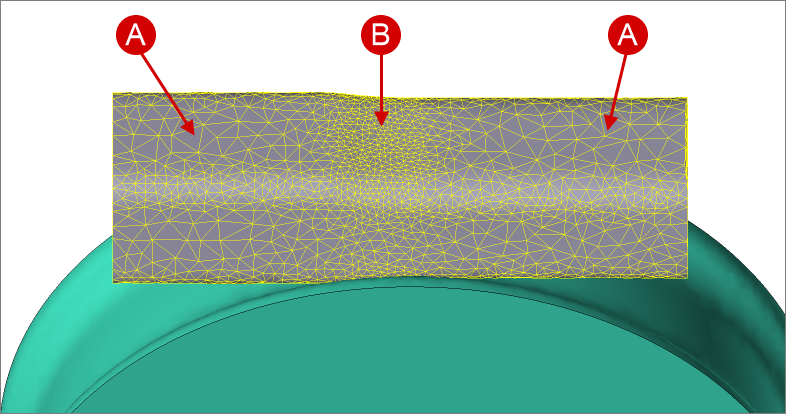
4.Temperature distribution. The temperature field must be calculated accurately not only in the contact area but also in the rigid zone. This is especially important if the technological process includes several operations. In the rigid zones heat exchange with the environment occurs and temperature is redistributed over the material volume. To take these facts into account in longitudinal rolling problems, the dual mesh method is used; it employs two meshes for simulations of this type: a mechanical mesh and a geometrical mesh. This method makes it possible to consider the features of processes with local location of deformation zones and to accelerate the simulation. |
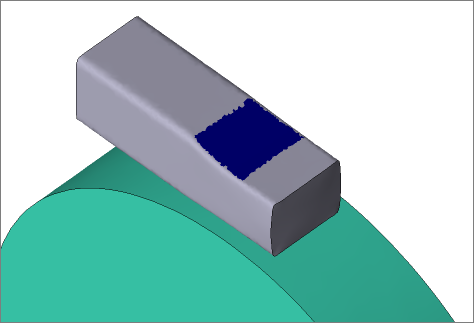
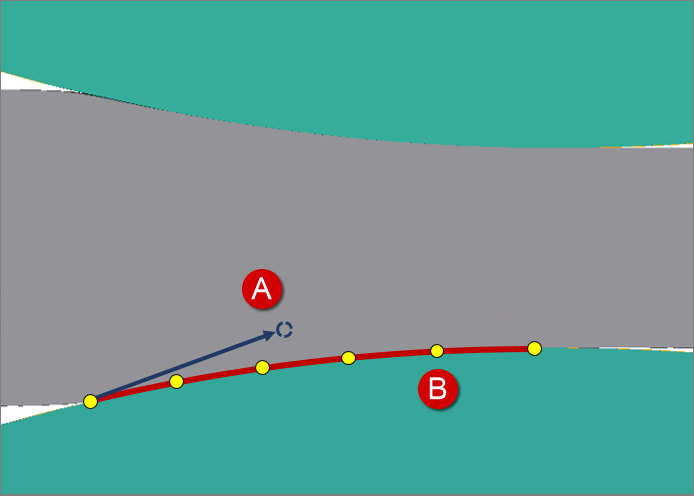
A material point of the workpiece that has come into contact with a roll must maintain this contact until it leaves the deformation zone. The method of determining node positions in FEM creates certain difficulties in meeting this requirement: 1.We know the current node position; 2.Determine the velocity vector at the current moment in time; 3.Calculate the simulation step; 4.Multiply the velocity vector by the step; 5.Obtain the node coordinate at the next step. Because of the algorithm specifics, the workpiece volume may change during the simulation. In this module this is accounted for, and the workpiece volume remains constant. The velocity of nodes in contact is always tangential to the roll surface. Therefore, at the next step a node is likely to detach and lose contact with the tool. A special node-position refinement method is used to solve this problem:
The quasi-stationary method accelerates longitudinal rolling simulation by adding extra sub-steps between simulation steps without loss of result quality, thanks to the Multistep shift option. |
The Longitudinal rolling module uses the Dual mesh method by default to make optimal use of computer resources, obtain reliable simulation results, and speed up the simulation. To solve the problem more accurately in the deformation zone, QForm UK automatically refines the mechanical mesh of the workpiece in the contact area with the tools. To control the mesh in the roll gap area, use Mesh parameters in tool contact area (see Simulation parameters). Beyond the deformation zone the mechanical mesh of the workpiece is not additionally refined, which positively affects simulation speed.
|