The subroutine calculates a set of fields that enable the evaluation of the depth of wear on the tool's surface after the deformation of the workpiece.
Subroutine parameters
Parameter name |
Dimension |
Comment |
|---|---|---|
wear_traction_coefficient |
Dimensionless |
Empirical coefficient in the model |
wear_pressure_coefficient |
Dimensionless |
Empirical coefficient in the model |
a |
Dimensionless |
Empirical coefficient in the model |
b |
Dimensionless |
Empirical coefficient in the model |
Output fields
Field name |
Dimension |
Comment |
|---|---|---|
wear_traction |
Length |
Surface field showing the depth of wear from shear stresses in contact with the workpiece |
wear_pressure |
Length |
Surface field showing the depth of wear from pressure in contact with the workpiece |
The subroutine allows for the evaluation of tool surface wear, without the need for stress analysis in the tool.
|
Comparing the field intensity of wear_pressure with the actual wear of the tool |
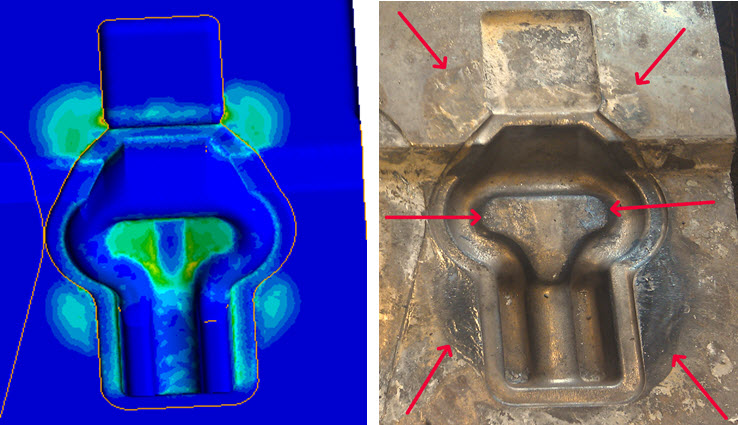
To determine the depth of wear, it is necessary to specify empirical coefficients. In practice, the wear_pressure field provides a fairly accurate prediction of the depth of wear on the contact surface.
To calibrate a coefficient, such as wear_pressure_coefficient, it will be necessary to simulate the manufacturing process for which the wear of dies is known after several thousand forgings under your production conditions.
Let's consider an example of adjusting the value of an empirical coefficient. Let's assume that after 3000 forgings the die wear in the most obvious area is 0.5 mm. The value of the wear_pressure field at this location is 0.005 with default coefficients. Then divide 0.5 by 0.005 to get 100. Thus, the value of the empirical coefficient wear_pressure_coefficient for assessing the depth of wear on the tool surface after 3000 forgings in similar processes in your production will be 100.
Wear model
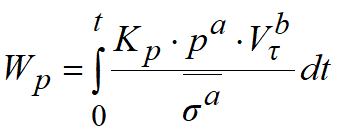
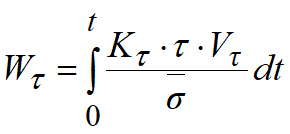
The wear of the tool is calculated using the following formulas:
 ;
; 
where:
 and
and  - tool wear due to normal pressures and shear stresses;
 and
and  - empirical coefficients (wear_pressure_coefficient and wear_traction_coefficient in QForm UK interface);
a and b - empirical coefficients (a and b in QForm UK) interface;
 - slippage velocity of the workpiece nodes relative to the tool [m/s];
 - normal pressure at the point of contact between workpiece and tool [MPa];
 - shear stress at the point of contact between the workpiece and the tool [MPa];
 - Yield stress of the tool material [MPa];
 - contact time of workpiece with a tool [s].