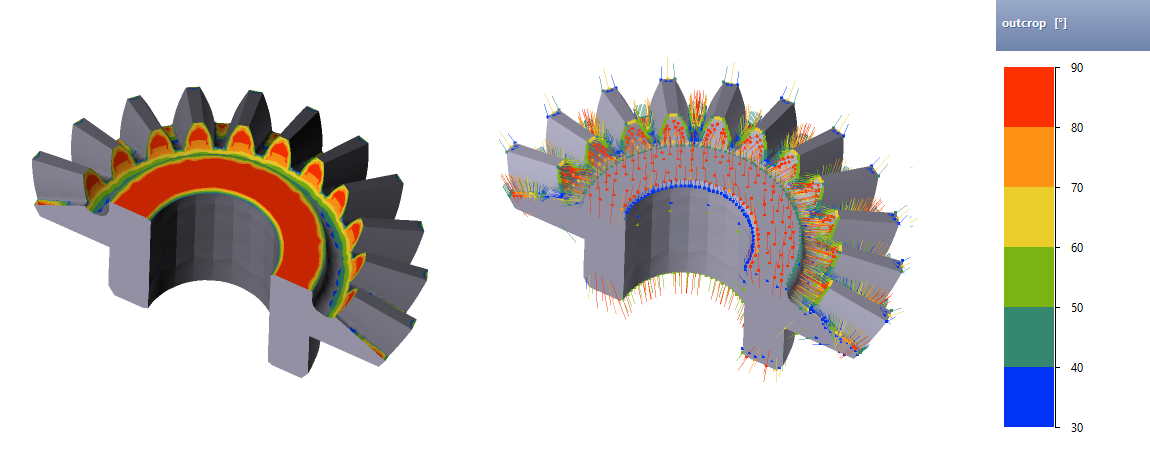
The subroutine calculates a set of fields that allow to analyze the change of the angle of fiber exit on the surface of the workpiece during its deformation.
Subroutine parameters
Parameter name |
Dimension |
Comment |
|---|---|---|
Limiting angle |
Angle |
The angle between the workpiece surface and the fiber extending to the surface. In areas of the workpiece surface where the angle of fiber extending is less than this parameter, the field is not displayed |
track_x, track_y, track_z |
Dimensionless |
The components of the unit vector that define the direction of the initial fibrousness |
Output fields
Field name |
Dimension |
Comment |
|---|---|---|
track |
Dimensionless |
Vector field displaying the current direction of the fibers |
track_x, track_y, track_z |
Dimensionless |
The components of the vector field track |
outcrop |
Angle |
The surface field and the directional field, displaying the current angle between the workpiece surface and the fibrous structure extending onto the surface |
outcrop_x, outcrop_y, outcrop_z |
Angle |
The components of the directional field for outcrop |
The fibrous structure of metals appears as a result of preliminary operation during which intense strain occurs in one direction. Typical technological processes leading to the appearance of obvious fibrous are: extrusion, rolling, drawing.
In the subroutine, an assumption is made that there is no need to calculate the evolution of microstructure and account for the anisotropy of mechanical properties in the fibrous structure. Instead, the tracking of changes in the direction of the fibrous structure occurs as a result of the deformation of the workpiece material during its flow.
The figure below shows the initial direction of the fibrous structure, defined along the cylinder axes. The fibers extend at a right angle to the surface on the end faces
|
The angle at which the fibers extend onto the surface of the initial workpiece |
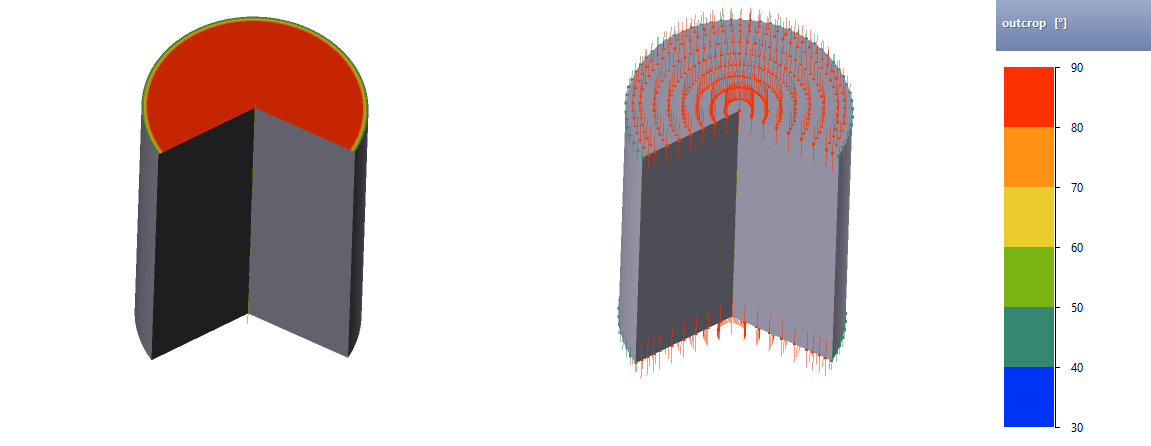
During forging, a redistribution of the field takes place. In areas of the surface where the field is not displayed, the fibers are oriented parallel to the surface.
|
The angle at which the fibers extend onto the surface after forging |
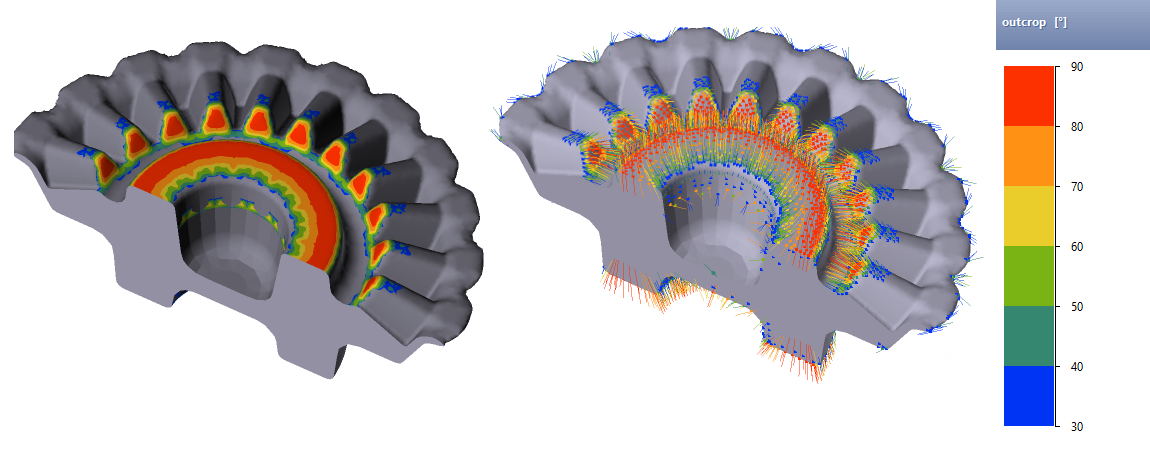
However, it is possible for new areas to emerge where the fibers extend perpendicular to the surface. These areas may become noticeable after removing allowances during subsequent mechanical processing, and the subroutine is capable of detecting them.
|
The angle at which the fibers extend onto the surface after mechanical processing |