
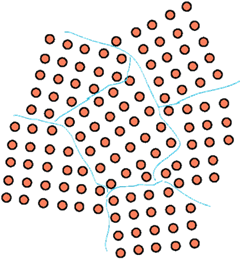
Metals and alloys used in industry, for the most part, have a crystalline structure, i.e. their atoms are arranged in space in an orderly manner at the nodes of the crystal lattice. In a polycrystalline material, individual crystallites are formed simultaneously in several regions of the volume, in which favorable condition are created for the emergence of a stable nucleus. The growth of crystallites occurs predominantly along certain crystallographic directions, determined by the nature (structure) of the nucleus and the conditions of crystallization. In the process of crystallite growth, there comes a torque when they collide, and a boundary forms between them. If the misorientation of crystallographic directions in neighboring crystallites exceeds 10-15 degrees (high-angle boundaries), they are called boundaries. grains. In what follows, only processes that change high-angle boundaries will be mentioned.
The grain structure is characterized by the dimensions of grains (crystallites), their dimensions distribution, crystallographic orientation (texture), the nature of the boundaries separating neighboring grains, their curvature, the regularities of their atomic structure, the angles at triple junctions of grain boundaries and the degree of their balance, the presence and nature of intragranular imperfections (type, concentration and nature of the distribution of point defects, pores, dislocations, low-angle boundaries), secondary phase , etc. The most important parameter is average grain size, which is a statistical value and characterizes the mean value of the grain size. There are many ways to simulation the average grain size in both homogeneous and inequigranular structures. Changing the type and parameters of the microstructure has a significant impact on the structure-sensitive properties. Structure-sensitive properties and processes include those mechanical and physical properties of materials and technological processes that are associated with the displacement of interatomic, atoms and atomic groups, dislocations, low-angle and high-angle grain boundaries, electric charge carriers (electrons, ions), electric , magnetic, optical, sound, thermal (photons and phonons) and other fields. The most important structure-sensitive processes are plastic Strain, diffusion, aging, sintering, electrical conductivity, thermal conductivity, magnetization and demagnetization, etc. The Basic processes that change the grain structure process strain and heating are recrystallization And grain growth. |
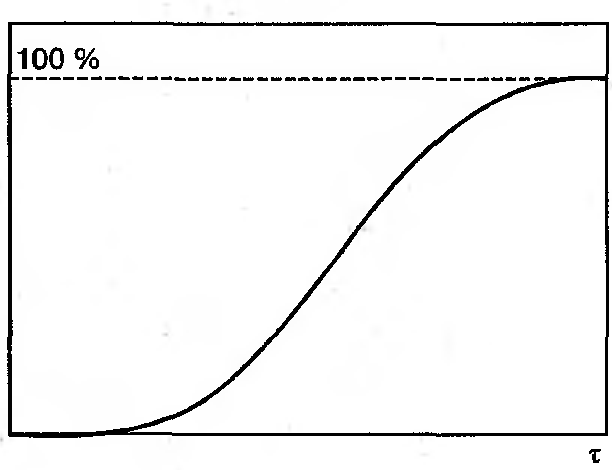
The State of deformed (riveted) metal is thermodynamically unstable at all temperatures. The free energy of such a metal is greater than that of annealed metal due to the energy of structural imperfections created during hardening. Since the type, concentration and nature of the distribution of structural imperfections are very diverse, their elimination during heating is realized by various elementary processes that require different energy. The Reference of such energy is the energy of thermal vibrations of atoms. Unlike polymorphic transformations that occur at strictly defined temperature and pressure and are accompanied by an abrupt change in free energy, the transition of a deformed metal from a metastable to a more stable state with a lower free energy (a lower concentration of various type of structural imperfections and their more energetically favorable distribution) occurs in a certain temperature range and duration of heating. One of the basic processes of evolution of the microstructure of cold-worked metals during heating is recrystallization. Under recrystallization (in domestic literature it is called primary recrystallization) understand the process of complete or partial replacement in polycrystalline solids of some grains of a given phase, containing certain structural imperfections, by other, more perfect, grains of the same phase. Primary recrystallization begins when heated after strain. The Temperature of its origin is the lower, and the temperature interval between the origin and end of primary recrystallization for single-phase alloys is the narrower, the greater the strain. Primary recrystallization begins after a certain incubation period. The Velocity of primary recrystallization at the initial torque of time is equal to zero and then increases, passing through a maximum. The scheme for changing the velocity of the recrystallization volume fraction has the view of a sigmoid- type curve.
Primary recrystallization occurs due to two processes - the nucleation of centers and the growth of nuclei, their velocity is determined by the nucleation velocity and the growth velocity , respectively.
The kinetics of recrystallization is similar to the kinetics of phase transformation, also occurring by the mechanism of nucleation and growth, and is quite well described by the Johnson-Meil-Avrami-Kolmogorov equation.
The nature of the structure by the end of primary recrystallization is determined by the nucleation and growth rates, which, in turn, depend on a very large number of factors - the conditions and strain, the heating velocity and temperature , the atomic and phase composition of the deformable material, the presence of dispersed and secondary phases, the initial average grain size and grain size, etc. |

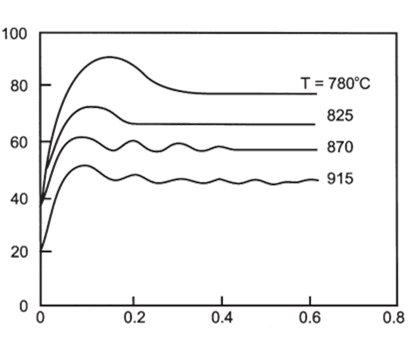
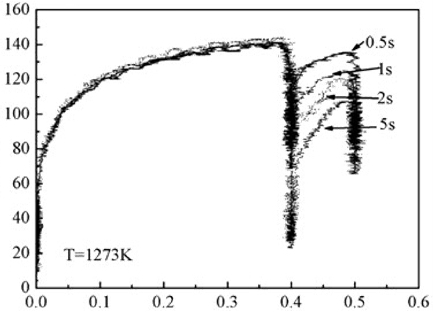
Hot plastic Strain of metals and alloys is a process widely used in practice. It includes strain in a wide range of temperatures, degrees and speeds - from slow superplastic strain or creep to high-speed processes of broadband or section rolling, open die forging, forging , etc. The most important difference between hot strain and cold deformation is that directly stroke hot strain two competing process simultaneously take place in the metal - hardening and intense softenning. Strengthening is caused by an increase in the density of dislocations under the influence of mainly external forces. The Processes of softenning consist in a decrease in the density of dislocations, as well as in their redistribution with the formation of more stable configurations: low-angle subboundaries and high-angle grain boundaries. The Basic processes of softenning during hot strain are dynamic and metadynamic (post-dynamic) recrystallization. Dynamic is called recrystallization occurring in the process of strain. In this case , recrystallization does not begin immediately, but after reaching the critical strain, which is determined by the thermomechanical conditions of strain and the initial parameters of the microstructure. Dynamic recrystallization can be detected by a characteristic peak on the flow curve. With continued strain, the recrystallized grains are deformed, which can lead to cyclic recrystallization, which is expressed in the oscillation of the stress- strain curve.
Metadynamic recrystallization occurs when holding at a high temperature after strain and differs from static recrystallization in the absence of an incubation period due to the presence of ready-made recrystallization centers and therefore often proceeds rapidly. For example, in [Shen, 2017] , metadynamic recrystallization occurs completely within 5 s of exposure.
|
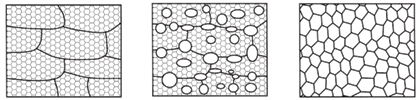
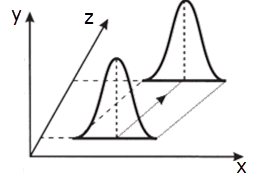
The Process of homogeneous coarsening of grains when a stress- free metal is heated to high temperatures is described as a grain growth process . Usually, grain growth is seen as a process following primary recrystallization (sometimes referred to as collective recrystallization). It is generally accepted that the main thermodynamic driving load of collective recrystallization is the desire to reduce the grain-boundary ("surface") energy and balance the grain-boundary ("surface") tension of the joining boundaries, realized in the reduction of boundaries during their migration and the establishment of an equilibrium configuration of grain boundaries. The grain dimensions distribution curve stroke collective recrystallization does not change its view, but only shifts towards larger dimensions.
The dependence of the average grain size on the exposure time is usually described by the following formula:
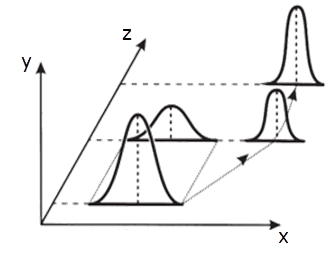
In some cases, after recrystallization, abnormal grain growth, also called secondary recrystallization, can occur. This process is carried out through the mechanism of nucleation and growth of nuclei and leads to a significant inhomogeneity of the microstructure.
In some cases, such as during state strain , grain growth is also possible process strain in parallel with recrystallization processes . Also, the process of coarsening of microstructure of heterophase materials can be considered as a process of grain growth. |

1.Gorelik S.S., Dobatkin S.V., Kaputkina M Recrystallization of metals and alloys. 3 ed., revised. and additional - M.: MISIS, 2005. - 432 p. 2.Bernshtein M Structure of deformed metals. M.: Metallurgy, 1977. - 431 p. 3.Arzamasov N, Sidorin I.I. Materials Science (Volume 1). Textbook for higher technical educational institutions. N Arzamasov, I. AND. Sidorin, G F. Kosolapov and others; Under total ed. N Arzamasov. - 2 ed., Rev. and additional - M.: Mashinostroenie, 1986. - 384 S.: ill. 4.Hessner F. (ed.) Recrystallization of metallic materials. Per. from English. - M.: Metallurgy, 1982. - 352 p.: ill. 5.Shen, Wenfei, et al. "Metadynamic recrystallization of Nb–V microalloyed steel during hot deformation." Journal of Materials Research, 32.3 (2017): 656-665. |